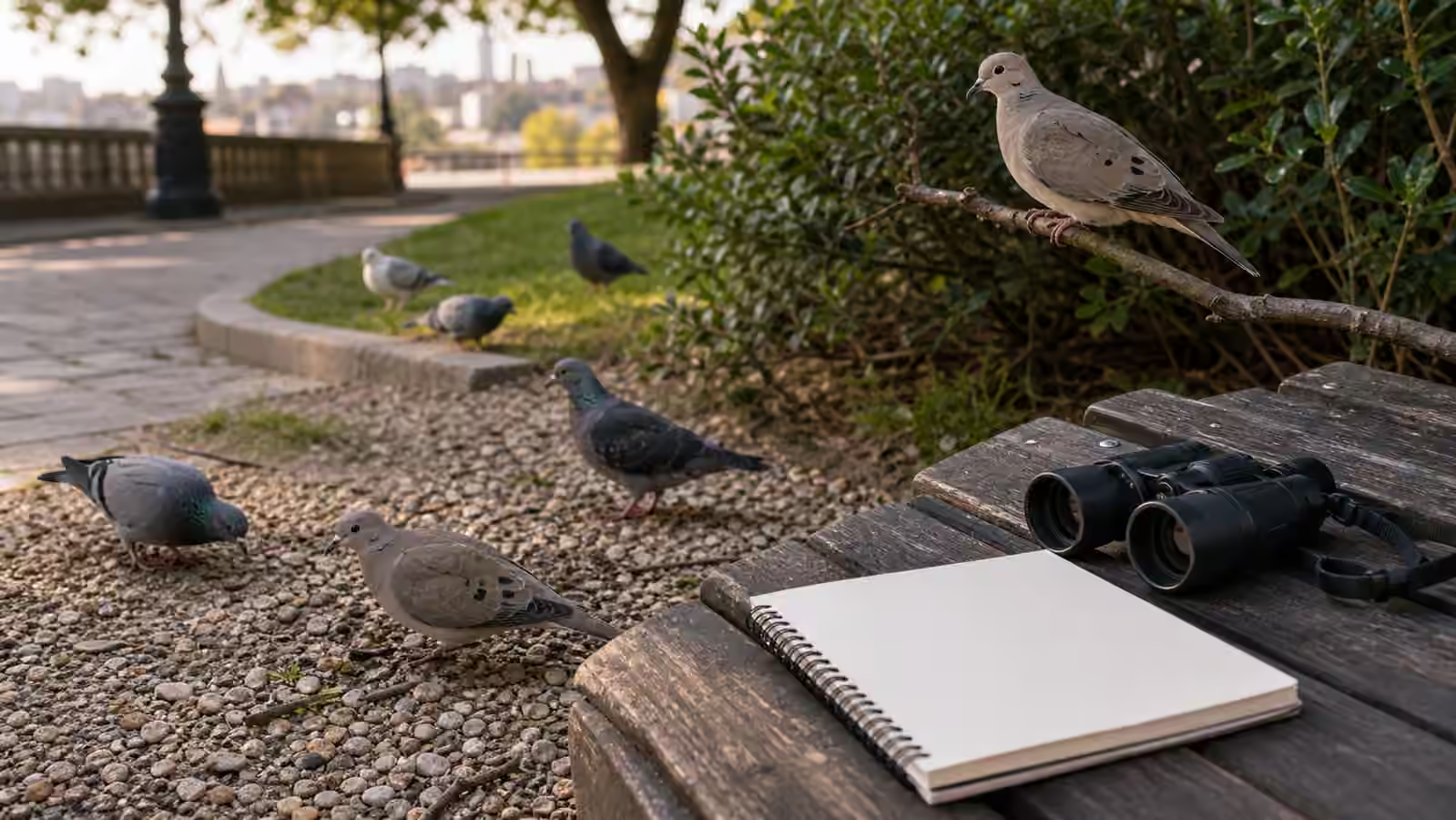
Pigeons and doves are easy to overlook because they are often too familiar. A bird on a sidewalk, wire, park bench, rooftop, farm track, or backyard fence can seem like background before the binoculars even come up. That habit costs beginners a useful lesson. Common birds are not lesser birds. They are the birds that let you practice fieldcraft every day, in mixed light, at close range, and without the pressure of a rare sighting.
Pigeons and doves reward slow looking because they combine simple shapes with subtle behavior. They walk rather than hop. They feed on the ground with steady head movements. They launch into fast direct flight. Many have soft, rounded bodies, small heads, short legs, and wings that can flash pale or dark marks when they lift. Once you start noticing those details, the ordinary bird beside the path becomes a good training partner for harder birding.
This guide fits naturally after Urban Birding and How to Identify Birds Without Guessing . It keeps the identification process grounded in birds you can see often, then asks you to describe them as carefully as you would describe a warbler or raptor.
Start With Shape Before Color
The pigeon and dove family often looks round at rest, but that roundness can hide useful differences. Look at the head size, neck length, body depth, tail length, wing shape, and posture. Some city pigeons look heavy and blocky, with broad chests and short necks that puff or flatten as they move. Many doves look slimmer, smoother, and longer-tailed. Some hold themselves upright on wires. Others stay low and horizontal while feeding.
Color can mislead because domestic and feral pigeons vary widely. One bird may be blue-gray with dark wing bars. Another may be pale, rusty, mottled, blackish, or almost white. If you begin with color, the flock can feel impossible. If you begin with structure and behavior, the variation becomes less distracting. You can say that several birds shared the same compact pigeon shape even when their plumage differed, or that a slimmer dove-like bird with a long tapered tail was using the edge of the group differently.
Light changes the lesson too. A dove in shade may look plain brown. A pigeon in sun may show a green and purple neck sheen that disappears seconds later. Treat those colors as observations, not as the whole identification. The better question is what the bird was built like and what it was doing.
Watch The Walk
Pigeons and doves are excellent birds for learning gait. Many beginners notice flight first because a flock lifting from pavement is obvious. The walk is quieter and more instructive. These birds often move with a deliberate head-bobbing rhythm as they feed. The head movement is not decoration. It helps stabilize vision while the bird steps through a world full of small seeds, crumbs, grit, sprouts, and insects.
Watch how a feeding bird chooses its path. It may move in a loose line, pause, peck several times, angle toward cover, or join another bird without seeming to hurry. A flock can spread across a lawn or plaza and then tighten when a person, dog, bicycle, or raptor changes the risk. This is where Reading Bird Behavior for Beginners becomes practical. You are not only identifying a bird. You are reading comfort, caution, feeding, and group response.
Common birds make this easier because you can watch them long enough to see the pattern. A dove that keeps feeding while you stay still is giving you one kind of information. A pigeon that stops, raises its head, and walks away before flying is giving another. If your approach changes the bird’s behavior, your presence has become part of the observation.
Flight Gives A Different Field Mark
When pigeons and doves take off, their soft ground presence turns into strong flight. Pigeons can lift explosively, circle buildings, clap or whistle with the wings depending on species and situation, and settle again in a coordinated sweep. Doves often show pointed wings, quick wingbeats, and sometimes a long tail that changes the whole silhouette.
Flight is useful because color may vanish at distance. A pale wing flash, a dark tail band, a long wedge-shaped tail, or a stocky direct flight can be easier to notice than feather detail. Flight Style and Wingbeats teaches this broader habit. With pigeons and doves, the lesson is close to home. A bird flushed from a sidewalk, a pair crossing a field, or a flock circling over rooftops can all teach you to read movement before the bird lands.
Do not chase a bird for a better look after it flushes. Notice where it went and why it left. Did the flock lift because of you, a passing car, a dog, a hawk, or another pigeon? Did the birds circle and return, or did they move to a safer roof? The reason for flight is often as interesting as the flight itself.
Voice Makes The Familiar Stranger
Dove and pigeon voices can fade into the background until you decide to listen. Cooing from a roofline, a repeated phrase from a tree, wing noise at takeoff, or soft contact sounds in a group can all become field marks. The sound may be lower, softer, more rhythmic, or more resonant than a beginner expects.
Birding by Ear suggests learning anchor birds first, and pigeons and doves can be excellent anchors. Their voices often come from predictable places, so you can connect sound to posture and habitat. A bird calling from a wire gives one lesson. A hidden bird cooing from a dense tree gives another. Once you know those local sounds, a different cooing voice stands out more quickly.
If you record a sound, keep the context. A short note that says the bird was calling from a rooftop at sunrise, or from a dense ornamental tree beside a park path, will be more useful than an unnamed audio file. The sound belongs to a place, a posture, and a moment.
City Birds Still Deserve Distance
Familiarity can make people careless around pigeons and doves. They are stepped around, chased by children, fed poorly, photographed too close, or treated as if their tolerance means consent. Good birding does not reserve respect for rare or shy birds. A bird that lives near people still has feeding time, rest time, alert behavior, and limits.
The etiquette lesson from Birding Etiquette and Field Notes applies in a plaza as much as in a marsh. Stay out of the bird’s path. Do not throw food to force behavior. Do not push a flock into flight for a photo. If you are watching from a bench or window, let the birds use the space they have chosen. The fact that a pigeon can tolerate people does not mean every person is harmless at every distance.
This is also why notes on common birds matter. Write the location, flock size, feeding behavior, voice, and response to disturbance. A note such as “six pigeons on station roof” fades quickly. A note that says “mixed-color pigeon flock feeding along gravel edge, lifted when dog passed, returned to same shade after two minutes” preserves a small piece of city bird life.
Let Common Birds Improve Your Eye
The best reason to study pigeons and doves is not that they are difficult. It is that they are available. They let you practice the same sequence over and over: shape, behavior, habitat, voice, movement, and then field marks. They teach you to respect variation without panic. They remind you that a bird does not become uninteresting because it is common.
After a few careful sessions, the background changes. You notice the dove on the wire before it calls. You separate a stocky pigeon from a slimmer dove in flight. You see a flock tighten before it lifts. You write better notes because the subject stayed long enough to let you practice.
That habit carries into the rest of birding. The next time a less familiar bird appears at a water edge, in a woodland, or over a field, your eye already knows how to begin. The common birds trained it.